

Often as we get older the way we interact with the environment around us changes. Let’s take the heart of any home, the kitchen as an example. Have you ever considered the many interactions that occur within a kitchen? We are talking much deeper than a place to house a sink, cooker and some white goods.
When we think about how our human-to-human generational interactions are forever changing we can also appreciate how human factors and ergonomics have their own reciprocal relationship. Consider the change element such as the addition of small children or multigenerational living. These changes will affect the way in which we interact within our kitchen and how we need it to respond. Variability in our population such as age, size, strength, and cognition will inevitably lead us to ask such questions:
– Is my kitchen effective?
– Can I carry out my activities of daily living, with ease?
– Can I improve the usability factor?
The science of ergonomics is understanding one’s relationship with the environment and optimising the human well-being element for ultimate system performance. At Kitchen Kind we begin by ‘Assessing’ through listening carefully to what works and what does not. This is key in achieving an ergonomic kitchen. The next process is to evaluate the human factor and the system, where we can then apply 25 years of experiential knowledge in both the kitchen industry and healthcare industry and find the perfect solution. This process means that changes can be made to ensure that the kitchen can continue to be a place of meaningful interactions and increased well-being.
Theory into practice
Kitchen Kind recently completed a kitchen alteration to help improve the practicality of cooking every day a little bit easier. Whilst the cooker in situ was a perfectly sound, working range cooker, it was proving too difficult for the owners to manage in terms of bending down and lifting food out of the oven. More storage space was also required. Kitchen Kind felt it would be beneficial to remove the Range cooker and it was replaced with an inset induction hob which would be far easier for the owners to use and was much better suited to their needs. We solved the storage issues with storage drawers below to match the existing cabinetry.
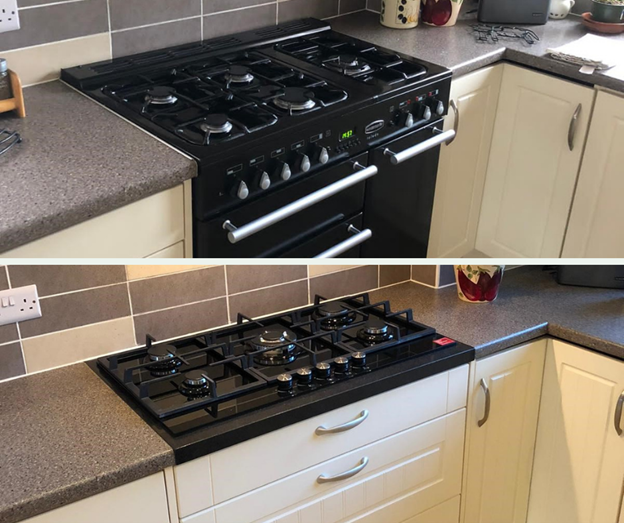
Furthermore, a new built-in oven with storage housing above and below was moved to a practical height to prevent unnecessary bending. This further increased storage capacity and meant cooking would no longer be an arduous task and the kitchen would work for its owners and not the other way around.

The kitchen should remain a space to be enjoyed even as our lives and requirements change. We can adapt the kitchen to reflect those changes so it continues to serve us in a way that suits our needs.
No job is too big or to small, it has just got to work. The interaction with one’s environment is an important aspect to our service. Kitchen Kind understand the connected relationship between human factors and optimal kitchen function and we use that knowledge to create a space that works on a deeper level than a purely aesthetic one. If you would like to discuss your ‘Kitchen Drama’ we would be delighted to hear from you.